A niche blog template

Sunday, 5 June 2016

Biomechanics and Sports

16:09 Posted by Unknown No comments

biomechanics and sports

Biomechanics


Biomechanics is made from two words i.e." Bio" ( meaning: a living body) and "Mechanics"  (Meaning:Field of physics which deal in the study of bodies in motion).   Application of the principle of mechanics in physical education and sports is called biomechanics.

Projectile and Trajectory/Parabola


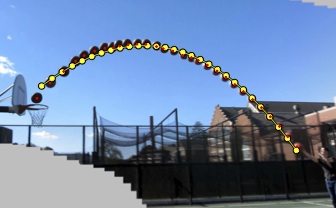
A projectile is anybody thrown upwards with an acute angle is known as the projectile .For example, A basketball is thrown towards the basket ,ball thrown by fielder towards baller, throwing a hammer, discuss throw etc. In all these cases objects are considered as the projectile. Trajectory is the path covered by the projectile until it stops.let's understand it better with an image.
Projectile and trajectory meaning with the help of angry birds


Factors Affecting Projectile Trajectory (Object's path)

There are various reasons of the path of the projectile.Different bodies use different paths due to the following reasons:

  1. The angle of Projection

  2. Height of Release

  3. Initial Velocity (or speed)

  4. Gravity (or the weight of the projectile)

  5. Air Resistance

  6. Spin

The angle of projection- The angle of projection affects the distance covered by the projectile. If the angle would be too less or too high then distance covered will be less, so to cover the proper distance the angle of 45°.is recommended.

The height of Release- Height of release refers to the height to which the projectile is released.It is observed that as the height of the release of projectile increases, the distance also increases.

Initial Velocity- The speed at which the projectile is thrown in the air is called as initial velocity.The more the initial velocity will be , the more will be distance covered by the object and vice versa.

Gravity- Gravity is an invisible force that pulls everything towards earth.The more the weight of the projectile , the more the weight the more the gravity acting upon it.

Air Resistance- When any object passes through air, it faces some resistance by air around it.This resists the movement of the projectile through the air.It depends on various determinants such as the surface of the object, design (or shape) of the object, the mass  of projectile and speed of the projectile.

  • The surface of the object- If the surface is smooth , then air resistance would be less and if it's rough then resistance would be more.

  • Design- Design refers to the shape of the object. If the shape is piercing (as that of an aeroplane)  then the air resistance will be less and if it is not piercing but is a made to capture more and more air (like a parachute and a skydiver making an arch position).

  • Mass of the object- Mass is the matter possessed by the body.If the mass of projectile would be small then resistance will be high and vice versa . For example feather and a stone.

  • The speed of the projectile- The more the speed the farther will projectile go.For eg a stone thrown and a bullet fired from a gun.

Spin- The amount and direction of spin acting on a projectile affect the distance travelled by the projectile. Topspin (what is topspin) reduces the distance whereas backspin (what is backspin) increases it.

Angular and Linear movement

Angular movement is produced with angle whereas linear movements are movements in a single direction.
Most human actions are the complex combination of basic forms of motions such as linear motion, angular motion, and general motion.


Linear Motions

Motion along a straight line curve is called linear motion .It can be in straight line or in curved lines.The direction of a moving object will not be changed .There are two types of motions: Rectilinear motion and curvilinear motion.


Rectilinear motion- The movement along the straight line curve is known as rectilinear motion.For example bowling ball etc
Learning rectilinear motion with sports
Rectilinear motion
Curvilinear Motion- The movement along the curved path is known as curvilinear motion.

Curvilinear motion with the help of basketball
Curvilinear Motion

Angular Motion

Motion possessed by anybody moving around an axis is known as angular motion.It is further classified into 2 types i.e. Internal axis and External axis.
Internal Axis- If the axis of the rotating body  lies inside the human body then it is considered as an internal axis.Such as games such as hammer throw etc.

External Axis- If the axis of the rotating body lies outside the human body then it is termed as an external axis. For example giant wheel, moving ceiling fan etc.


Work, Power and Energy


Work-When there is displacement of the body in the direction of force applied then it is said that the work is done.{\displaystyle W=Fs}where w=work,f=force applied,and s=displacement.Components of work done are the force applied on a body and the displacement covered by the body after applying force.

Power - Power can be defined as the rate of doing work or rate of consuming the energy.

P=W/T

Where P=power, Work= work, T= Time

Energy-Energy can be defined as an ability of an individual to do work.It is categorised into two types: Kinetic Energy and Potential Energy.
Kinetic Energy-Energy possessed by a moving body is know as kinetic energy. there is the positive relationship between the movement of the body and kinetic energy.The more the movement the more will be kinetic energy and vice versa.

Potential Energy- Energy possessed by a body at some height is known as potential energy.its main component is the height and weight of the body.


Saturday, 14 May 2016

Training in sports

18:50 Posted by Unknown No comments
training in sports physical education class 12

Intro


This chapter focuses on identifying,understanding and developing various types of abilities of the body.It covers a great weight age in the examination.

Training


It is the preparation of the athlete in such a way that he can perform as per the requirements in the competitions.The performance of an athlete in such competitions  depends widely on abilities such as speed,endurance,strength etc which are developed during training sessions.

Strength


Strength meaning

Strength is the ability of the body to act against resistance.

Types of Strength

Strength can be classified as follows:

Dynamic Strength

Dynamic strength can be called isotonic strength because it is related to movements.In pullups and pushups, we require dynamic strength.In performing such workout,there is a diminishing tendency in dynamic strength and as a result,muscles refuse to work.At this juncture, a person is not able to do one extra pullup or pushup.

Types of Dynamic strength

Dynamic strength is classified into 3 parts:

  1. Maximum Strength- it is the ability to act against maximum resistance.Maximum strength is not usually used in the majority of sports.It is used in those sports in which very heavy resistance has to be tackled, e.g.,Weightlifting,Shot-put,hammer throw etc.In other sports maximum strength is required for a short period, e.g., cross position in roman rings in gymnastics, starting and accelerating phase in sprinting events, high jump etc.In such sports maximum strength is really very important.

  2. Explosive strength-It is defined as the ability to overcome resistance with high speed .In fact, it is a combination of strength and speed abilities.Explosive strength is generally used in sprint starts , weightlifting,shot put etc.In above-mentioned sports, this force is applied jus like an explosion, that's why it is called explosive power or explosive strength.

  3. StrengthEndurance-As the name speaks, strength endurance is a mix of strength and endurance abilities.If strength means to overcome resistance and endurance it is the ability to resist fatigue, then strength endurance is the ability of a person to act against the condition of fatigue.It can be a form of static strength or dynamic strength depending on factor whether the movement is static or dynamic.Static Endurance ability is generally used in long distance races,swimming,road cycling and pole vault.So it can allude that strength endurance is used in most of the sports.

Static Strength

Static Strength is also called isometric strength.It is the ability of muscles to act against resistance.Static Strength can be measured by a dynamometer.This type of strength is not seen directly.Static strength id not appllied in sports directly but in weight lifting it is applied in phases.

Strength Training

Strength Training is the term of improving the strength.It is classified into following 4 types:

  1. Isometric Exercises

  2. Isotonic Exercises

  3. Isokinetic Exercises

Isometric Exercises


Isometric exercise or isometrics are a type of strength training in which the muscle length do not change during contraction. Isometrics are done in  stable positions, rather than being dynamic through a range of motion.The main component of isometric exercises  is time , not weight.It involves trying to move a fixed object.It is used commonly for rehabilitation.(Tip: Iso-Metric-cannot be moved,even by single meter)

Isotonic Excercise


Isotonic exercises are those exercises in which movement can be seen directly.Isotonic Excercise tone up the muscles. Muscles become flexible, and length also increases. These exercises have great value in the field of sports and are considered best for  strength development. For e.g. running and jumping on the spot, weight training exercises, exercise with medicine ball etc.Isotonic Exercises can be performed with or without apparatus.

Isokinetic exercises


Isokinetic exercises are performed on specially designed machines. These exercises involve a special type of muscle contraction, which is usually not applicable in sports and games except rowing and swim. Isokinetic exercises ,movement occurs at the same speed. In isotonic  exercises muscle applies maximal force over a particular angle of its range of movements whereas in isokinetic exercises contraction of muscles applies maximal force throughout the complete range of movement.According to the individuals capacity, the speed of contraction can be adjusted accordingly. For eg. Lifting, pulling, gymnastics, diving etc.

Endurance


Endurance is the ability of the person to do sports movement with the desired quality and speed under the condition o fatigue.It involves a large number of muscles.In all sports , directly or indirectly endurance is used.It is usually measured by a number of repetitions.For eg. the number of situps a person can complete in one minute is often used to measure endurance of stomach muscles.

Types of endurance:


A.  According to the nature of the activity.
Basic Endurance

General Endurance

Specific Endurance

B. According to the duration of activity
Speed Endurance

Short-term endurance

Middle-term endurance

Long-term endurance


Types of endurance according to the nature of activity


According to the nature of activity, the endurance is classified into following types:

  1. Basic Endurance- Also known as aerobic endurance,because basic endurance depends mainly on aerobic endurance.In fact, basic endurance is the ability to perform movements in which large number of body muscles are involved and the activity is performed at slow speed or pace for a long duration.(such as jogging,walking, swimming etc.) Basic endurance forms the basis of all types of endurance.

  2. General Endurance- General endurance means doing sports activity in  the condition of fatigue.General endurance is not specific to any sports.It is developed through general exercises. The better the general endurance , better the performance in sports.

  3. Specific Endurance- Specific endurance is the ability to resist the fatigue caused by a particular sports activity.As the nature of fatigue is different from sports to sports, the specific endurance is different from sports to sports.For example, the specific endurance for a wrestler is to combat effectively in three rounds or six minutes, whereas it is 4 rounds for a boxer.

Types of endurance according to the basis of duration of activity.


According to the duration of activity, the endurance is classified into following types:

  1. Speed Endurance- Ability to resist fatigue in activities that last up to 45 seconds.For example.400m sprint.

  2. Short-term endurance- Ability to resist fatigue in activities that start from 45 seconds and last up to 2minutes.For example.800m race.

  3. Medium-term endurance- Ability to resist fatigue in activities that range from 2minutes to 11minutes.For example. 1500 m race.

  4. Long-term endurance-  Ability to resist fatigue in activities that last more than 11 minutes.for example. 5000m cross country, 10,000m race, and marathon requires such type of endurance.

Improving/developing Endurance


The following methods are used to develop endurance:

  1. Interval Training Method

  2. ContinousTraining Method

  3. Fartlek Training Method

Interval Training Method


Interval Training Method is the best method for improving endurance.In this method, exercise is done at high intensity and with intervals of incomplete recovery.

Let's check an example to understand better

  • Firstly exercise should be done with high speed until heartbeat comes to 180 beats per minute.

  • Rest should be taken until heartbeat comes to 120 or 130 beats per minute.

  • Training load should be controlled by checking the  heart rate.

Advantages of interval training method

  • It takes less time to do more workout.

  • Highly beneficial for the respiratory and circulatory system.

  • Progress can be measured easily.

  • Peak performance can be achieved in short duration.

  • Any fault can be cleared easily.

Disadvantages of interval training method

  1. Increased chances of injuries.

  2. Attracts heart diseases.

  3. The top performance cannot remain active till the competition.

Continuous Method

Continuous training is one of the best methods for improving endurance.In this method of training, an exercise is performed for a long duration without any break.In this method intensity remains low because this exercise is done for a long time without a break.In this method intensity remains low because exercise is done for a long time.For Example Cross-Country race, etc. In this method, the rate of heartbeat remains between 140-160 beats per minute.The total duration of exercise should not be less than 30 minutes.

Advantages of continuous training method

  1.  It increases glycogen in muscles and liver.

  2.  It increases the number and size of mitochondria.

  3.  It also increases the efficiency of heart and lungs.

  4.  It improves willpower and makes the individual well-determined under the condition of fatigue.

  5. For better results intensity can be increased.

  6. It makes the individual self-disciplined and confident.


Fartlek Training Method


Fartlek training method is used for developing endurance . This trail method lays emphasis on both the aerobic and anaerobic systems. In this method pace or speed is not preplanned so it is left up to the individual. He can change according to the surroundings(hills, rivers forests, muddy roads metal roads and grounds) or himself.Self-Discipline plays a vital role in Fartlek training method.  The rate of heart beat ranges between 40 to 180 per minute. The duration of training depends on  the experience of the athlete but most probably it lasts a minimum of 45 minutes, It can vary from  aerobic walking to anaerobic sprinting. This training method is usually linked with running but can comprise any type of exercise. For performing this training proper warm up should be done at the beginning and appropriate cooling down at training to improve performance and to reduce the chances of injury. An example of this training is given below.

  1. Warm up. Jogging or slow running for 5 to 10 minutes.

  2. Steady, hard speed for 1.5 to 2.5 km.

  3. Recovery, Rapid walking for at least 5 minutes.

  4. Start of speed work:Easy running between sprints of about 50 to 60 meters repeated start of speed work Easy running between sprints of until a little tired.

  5. Easy running with three or four quick and then.

  6. Full steps now speed uphill for 175 to 200 metres.

  7. The fast pace of 1 minute.

The above-mentioned routine is repeated until the total time prescribed on the training schedule has elapsed.

Advantages

  1.  it keeps the heart rate up allowing an athlete to get good cardio-vascular endurance.

  2.  It is good for aerobic and anaerobic fitness. That is why it makes an athlete a better runner and a better long distance runner.

  3.  Due to the sprinting intervals, it makes the body versatile.

  4.  It not rigid but flexible in nature.

  5. A number of athletes can take part in this training simultaneously. 

  6. In this training method, no equipment is required. Hence, it can be organised without any problem.

  7.  It is easily adaptable to the athlete.

Disadvantages

  1.  It is difficult to see how hard the trainee is making efforts.

  2.  Sometimes the athlete is likely to drop efforts .

  3. It may cause accidents because it is not  pre-planned.

  4. Appropriate check on trainees can not be maintained .

Speed


Speed is the ability to move from one place to another in the shortest possible time.It means that the velocity with which an individual can execute his movements. In other words, it means the capacity of moving a body part or the whole body ample, the movement with maximum speed or velocity.For example, the movement of smasher's arm in volleyball has the maximum speed or velocity at the time of smashing the volleyball.

Types of Speed in different sports


The main forms in which Speed appears in different f appears are stated below


  • Reaction Ability- Reaction Ability depends completely on coordinative processes.So it is also considered as a coordinative ability.Reaction Ability is the   ability to react effectively and quickly to any signal or action. In games and sports, signals can be of various types such as visual or tactile.In games and sports , reaction ability is not only significant to react quickly to a signal but the reaction should also be accurate according to the situation.Reaction ability can beClassified into two types: (a) Simple Reaction Ability- It is the ability  to react quickly in already determined a manner to a known signal. For example, the reaction of sprint races is already known to the racer.
    (b) Complex Reaction Ability- it is the ability to react quickly to undermined or unexpected signals, These are unexpected to read person because he does not know when and to which signals has to react such as facing a ball cricket by a batsman station.

  • Acceleration Ability-It is the ability to achieve maximum speed from a stable position or from the low-speed state. Generally, runners achieve their maximum after approximately six seconds. This ability mainly depends on upon explosive strength,  technique, and flexibility. This ability is important in all games and sports in which maximum speeds are to be achieved in quickly such as sprint races(short distance), hockey, football, and gymnastics etc.

  • Movement speed- It is the ability to do a movement in minimum time.It depends on upon technique, explosive strength, flexibility and coordinative in swimming and vital role in boxing, wrestling, throws, jumps, gymnastics turns in swimming and in the movement sprinting starts. It can be measured by the time taken to complete the movement.

  • Locomotor Ability- It is the ability to maintain maximum speed for maximum time or distance . This ability is very significant in only a few sports events such as 100m distance, 200m, 400m races, short sprints in track cycling, speed skating, swimming, football etc 

  • Speed Endurance-Speed endurance is the ability to perform movements speed under conditions of fatigue, Speed endurance is a very complicated ability which depends on upon explosive strength, speed, and endurance. It also depends on upon technique, local muscular endurance and lactic acid tolerance ability.


Methods to develop speed


In developing speed genetic factors may work sometimes but most of the share is occupied by the amount of hard work done by an athlete.Following are the ways to develop speed:

  1. Acceleration Runs

The acceleration run is introduced to develop speed , especially in attaining maximum speed from a stable position.Before starting acceleration run , the proper technique should be learnt properly to reduce the chances of injuries.In acceleration run, an athlete is required to run a specific distance in minimum possible time.This is to be repeated again and again in the presence of proper rest intervals between the runs.the maximum speed of runners is achieved within 6 seconds.After developing speed , good athletes can maintain speed for only 20 metres.

2. Pace Runs or Races

Pace runs or races include running the whole distance of the race at a constant speed.Generally, the chosen distance is 800 metres.Observations showed that an  athlete can run  up to 300metres for full speed so he requires conserving speed to cover the whole distance of 800 metres.For example,  if the best record of an athlete of running 800 metres is 1 minute 40 seconds ,then he should focus on covering first 400 metres for 50 seconds then another 400 metres for 50 seconds. This would help him decreasing  time and increases speed.For pace run , the athlete should run for maximum steady speed for 110%-120% of the distance .Proper tests should be taken before starting next repetition.In other words, this race includes keeping the sufficient energy for the second half of the race and not spending over the first half.

Flexibility


Flexibility is the range of movements of a joint.In ordinary words, it is the ability of the body to bend , twist etc.Flexibility helps to do day to day activities efficiently.It is determined by genetic factors and the amount of workout one do.Developing the flexibility helps to reduce injuries, develops postures, reduce low back pains etc.

Flexibility can be classified into two types:

  • Active Flexibility

  • Passive Flexibility

Active Flexibility 

The  flexibility movements performed without any outside help goes under this category.This is the easiest type of flexibility and can be seen in real life in the form of hamstring stretch,butterfly groin stretch ,shoulder stretch, triceps stretch,calf stretch etc.Active Flexibility is also into two types:

  • Static Flexibility - Performing an exercise  to increase the flexibility comes under the category of static flexibility.For example shoulder stretch, triceps stretch,calf stretch etc.Static flexibility is the flexibility possessed by a person in a stable position.

  • Dynamic Flexibility-The flexibility possessed by a moving body is dynamic flexibility.This is an essential part of some games or sports.For example gymnastics.

Passive Flexibility

The flexibility movements performed with the use of external help is passive flexibility.for example stretching exercises with the help of a partner.

Improving Flexibility


 Coordinative Abilities


The name coordinative abilities say it all.Coordination abilities refer to the ability of an individual to maintain the coordination between different body parts.The coordination can be in the form of muscle to muscle , brain to muscle etc.

Types of coordinative abilities


There are different types of coordinative abilities which are significant in different sports.The various types of coordinative abilities are:

Orientation Ability-The coordinative ability of an individual to determine body position and its parts to react upon a moving body.It depends on sensory organs.Its application can be seen in games such as basketball, football, volleyball, table tennis etc in which the balls are moving bodies.

Coupling Abilities-The coordinative ability of individual to use different body parts to react in sports or games is known as coupling abilities.It  can be seen in boxing , wrestling etc.

Reaction Ability-The coordinative ability of individual to react quickly to a signal. The signal can be in the form of light , sound etc.Reaction ability is further described into simple reaction ability and complex reaction ability.

  • Simple reaction ability-The ability to react according to a previously known signal in a defined way is known as simple reaction ability.For example reaction of a runner in a race .

  • Complex reaction ability-The ability of a person to react quickly to an unknown signal .Both reaction and signal are not defined.For example ball in football, ball in basketball, ball in cricket etc.

Balance Ability-The ability of individual to maintain or regain balance quickly in the body during and/or after the movement is known as balance ability.For example handstand on parallel bars, water skiing, performing on the balance beam.

Rythm Ability- Rhythm ability is the ability to observe or perceive of a movement and to do the movement with the required rhythm. In gymnastics or figure skating,  the sportsman has to observe an external rhythm,  given in the form of music and to express his movements. Rhythm ability is also required in synchronised swimming.In various sports, it is not given from outside,  The sportsperson uses the rhythm which is already stored in his motor memory. This type of ability is very significant in gymnastics,  synchronised swimming,  diving and figure skating etc.

 Adaptation Ability- Adaptation ability is the ability to adjust or change effectively on the basis of changes or anticipated changes in the situation The change situation can be expected one or can be sudden or unexpected one in other words,  it can be said that it is the ability to solve motor task,  effectively in spite of changed or changing situation.

Differentiation Ability- Differentiation ability the ability to achieve a high degree accuracy and economy of separate body movements and movement phases in a motor action.  The high level of this ability depends on movement experience and the degree of mastery over motor action.


Tuesday, 19 April 2016

Planning in Sports

04:33 Posted by Unknown 2 comments


Blog title of planning physical education class 12

1 Planning 


A basic management function involving the making of one or more  plans to achieve  needs or demands with the available resources.
In simple words it means deciding in advance what is to be done, when is to be done,how it is to be done and by whom it is to be done. ("it" refers to the task or goal or target or demand or need)

1.1 Objectives of planning


1. To reduce unnecessary pressure of immediacy.

2. To keep good control over all the activities.

3. To facilitate proper coordination.

4. To reduce the chances of mistakes.

5. To increase the efficiency.

6. To increase the creativity.

7. To enhance the performance.

2 Tournament


A series of contests between a number of competitors, competing for a prize.In other words it means competition between many teams.It is classified into 4 types:

  1. Knock-Out Tournament

  2. League (or Round Robin)

  3. Combination (Include all Combinations of above two Tournaments)

  4. Challenge Tournament (Out Of Syllabus)

Lets Know About Them

2.1 Knock-Out Tournament


This is the most common type of tournament in which teams play against each other, winner moves to next round whereas loser is eliminated from the tournament.Knock-out tournaments are best tournament when spectators or resources are less.

In Knock-out tournament,teams are made to compete with each other unless a single winner is decided.
Single elimination or knockout tournament


2.1.1 Advantages


  • Cheap to organise-As we know that number of teams keeps on decreasing  with the increase in rounds,so these tournaments are cheaper or economical to organise.

  • Raising standards-Knockout tournament works on the principle of either win or gets eliminated and  there is no second chance to  any team. So teams tend to give their best to win the tournament.

  • Time saving-Due to less number of matches , knockout tournament require less time to complete.

  • Less officials-Owing to less number of matches , the officials required for the matches will also be less.

2.1.2 Disadvantages


  • Good teams may be eliminated at beginning-It could be possible that due to some reasons good teams also get eliminated in an earlier round.

  • Lose of interest-Due to the elimination of good teams in initial rounds,spectators tend to lose interest in remaining rounds.

3 League tournament


Also Known As Round Robin Tournament.In this type of tournament All teams are made to compete with each other  for once (if it is single league tournament) or twice (if it is double league tournament).This tournament is often seen as producing the most reliable rankings. However, for large numbers of competitors it may require an unfeasible large number of rounds.

3.1 Types of league tournament

3.1.1 Single League tournament - League Tournament in which each team plays with all other teams for once are known as single league tournament

Number of rounds in single league tournament can be calculated by following formula

N(N-1)/2  where N represents number of teams

3.1.2 Double League Tournament- League Tournament in which each team plays with all other teams twice are known as double league tournament

Number of  rounds in double league tournament can be calculated by following formula

N(N-1)    where N represents number of teams.

4 Combination Tournaments


In combination tournaments , the number of teams are divided into four equal zones. all of them are made to compete accordingly  (depends on type of combination).After the competition winner from each zone is picked up and made to compete with other winners of different zones.

Types of combination tournament :
Combination tournaments are classified into following four types:


  1. Knockout Cum Knockout

  2. League Cum League

  3. Knockout Cum League

  4. League Cum Knockout

4.1 Knock-Out Cum Knockout

In Knock-Out Cum Knockout tournaments number of teams are divided into four groups which are later on made to compete with each other on knockout basis.Since this is knockout cum knockout tournament , the winners of the previous four groups are made to compete with each other on knock out basis . This will declare one team as a winner .

4.2 League Cum League

In League Cum League tournaments number of teams are divided into four groups which are later on made to compete with each other on league basis.Being a league cum league , all the winners of four teams are made to compete on league basis.This will declare one team as a winner .

4.3 Knockout Cum League

In Knockout cum league tournaments , divide number of teams into four groups,then they are made to compete with each other on the basis of knockout tournament , the winners from the four groups are made to  compete on the basis of league tournament This will declare one team as a winner ..

4.4 League Cum Knockout

In League Cum Knockout ,Divide number of teams into four groups,then they are made to compete with each other on the basis of League tournament,the winners form the four groups are made to  compete on the basis of the knockout tournament.This will declare one team as a winner .

5 Fixtures


Setting up fixtures means ,making arrangements of competition among teams. it includes deciding who will fight with whom,which teams will be competing in the first round and other rounds .It is primarily drawn for Knockout tournament,and league tournament(staircase method and cyclic method).

5.1 knockout tournament fixture


Seeding-The sorting of teams and fitting them in the fixture so that the stronger teams do not meet each other in the early rounds is known as seeding. The criteria for sorting the teams is their performance.The reason why seeding is used in tournaments is that if stronger teams lose the matches in initial rounds ,then there would be no interest left in the matches for spectators and since spectators are the main source of funding ,seeding is done.

A bye is a special privilege given to a team in the initial rounds because of which it gets exempted from playing in the first round and directly enters the second round. In knock-out (single-elimination) tournaments, if the number of participants is not a power of two (e.g. 16 or 32), byes are given to complete the fixture which automatically moves certain participants into a later round without requiring them to compete in an earlier one.

Byes to be given are calculated by subtracting the number of teams and a power of two (same or greater than a number of teams).Let's see some examples to understand it better.
Number of teams are 2 then byes will be

Power of two greater than number of teams-Number of teams  = number of byes

2-2 = 0

Number of teams are 3 then byes will be

Power of two greater than number of teams-Number of teams  = number of byes

4 - 3 = 1

Number of teams are 12 then byes will be

Power of two greater than number of teams-Number of teams  = number of byes

16-12=4 byes


After calculating a number of byes,we will see how to make a knockout fixture.

  1. Entering teams before doing anything- all the teams are arranged in a serial wise manner starting from lowest to highest.

  2. Dividing -the number of teams is divided into two zones.If the number of teams is in an even number , then they are to be divided equally, otherwise, they are calculated by the following formula.

For the upper half    (N+1)/2

For the lower half    (N-1)/2

N represents number of teams

In case when there are odd number of teams , upper half gets an advantage of one more team.


3.  Calculation of byes- it will be calculated on the process stated above.

4.Fixing the byes-The number of byes are fixed or allotted (to respective teams)  in a pre-defined pattern.

Let's say a number of teams are 12 and the accordingly number of byes are 16-12=4.then these byes will be allotted in the following manner.

  • First Bye will be given to the last team of the second half zone or the end of the whole fixture.

  • The second bye is given to the first team of the first half or the first team of the whole fixture.

  • The third bye is given to the first team of the lower half zone.&

  • The fourth bye is given to the last team of the upper half.

If u do it correctly it will end up something like this


As byes are given to some teams , they are made to compete in the second round and they don't have to do anything in the first round.

After this the remaining teams are made to compete with each other.

5. competition - After allotting byes , the remaining teams will compete to get a chance in the second round.A square brackets type pattern is made which helps the viewer to see the competition among teams , outside the pattern made , it is written that which team won, and it goes on until a one winner is left.It looks like this
making arrangements of teams in knockout fixture


Note: the numbers outside the square like patterns represent the winner teams , and they can differ . There is no predefined pattern or theory which can tell you its pattern because it is always dependent upon the hard work of teams , it is always random.

5.2 League Tournament Fixtures


The following methods are used for drawing fixtures in league tournaments:

  1. Cyclic Method

  2. Staircase Method

  3. Tabular Method(Out of Syllabus As per mycbseguide.com)

5.2.1 Cyclic Method league tournament fixture

In Cyclic Method league tournament  one team will be fixed in a particular position and all other teams will move in a particular direction.

If a number of teams are odd , then one bye will be kept in the match and its place will be fixed in the first position of the right side of the fixture.A number of matches played will be equal to the number of teams.This is so because the bye is also counted as a team .

Number of matches = Number of teams (Only When number of teams are odd)

If the number of teams is even , then team number 1 will be fixed in the first position ,right side and all other teams will go on changing their places.

Number of matches = Number of teams - 1(only when number of teams are even)

Let's see some examples:

When number of teams are 5
cyclic method of making knockout fixture

cyclic method of making fixture in knockout tournament


After the 5th round, it stopped because in next round team 1 will replace the team 2 in the 5th round and this will look same as round 1.

When number of teams are 6
cyclic method when teams are 6


5.2.3 Staircase Method of league tournament fixture

In Staircase Method of league tournament  ,fixtures are made just like a staircase.this method is the easiest method because no bye is given to any team and there is no problem of the even number of teams or odd number of teams.

It includes fixing matches of one team with all other teams and the winner is decided on the basis of points .


staircase method of making knockout fixture

6 Intramural and Extramural


Intramural Sports are those recreational sports which are played within a particular  school/college/institute.These sports are meant to motivate the students and developing their various skills such as leadership,coordination etc.It is the one of the best ways to motivate the students of institution who are interested in games and sports.


6.1.1 Objectives of intramural


  1. To provide recreation.

  2. To develop cooperation among children.

  3. To provide opportunity to children to do participate in sports.

  4. To find out the talented sports person.

  5. Develop leadership.

  6. Development of personality.

  7. Enables students to learn sports skills.

6.1.2 Advantages/Significance of intramural


  1. These activities are necessary to low down the fighting instinct of students.

  2. Intramural activities refresh the children and make them agile.

  3. These are helpful in physical ,mental,social,emotional developement of children.

  4. It lays stress on moral and ethical values of students.

  5. Provide a good source for recreation.

  6. Develops awareness for health among children.

  7. Provides good opportunities to students to participate in-game sand sports.

  8. help to develop leadership qualities in students.

  9. Talent search is possible through intramural.

  10. It serves as a a great source to develop interpersonal relations.

  11. Helpful in developing personality.


6.2 Extramural Sports are those recreational sports which ar played between different players/teams of different school/institution or an organisation.

6.2.1 Significance of extramural sports

  1. These competitions provide an opportunity to schools and teams to show their sports capabilities which enhance the image of school.

  2. These programs are essential for making and implementing the program of physical education more efficiently and effectively.

  3. it provides opportunity to take part in competition for other  students also  who are not a part of organisation or school.

  4. these activities are essential to provide appropriate knowledge of nw techniques of sports.

  5. standard of sports can be enhanced by such activities.

6.2.2 Objectives of extramural 

  1. To provide experience of sports competition to students.

  2. To check improvement in performance.

  3. Psychological development.

  4. To have sense of competition.

7 Specific Sports Programs


Specific sports programs are arranged recently to draw public attention on social issues.These events are arranged with specific objective by federation state government,NGO etc, to keep awareness among people about their health.Sometimes arrangement of these sports leads to very specific causes like AIDS,saving tigers,swine flu,cancer awareness etc.

7.1 Sports day


Sports day is a day which is meant to organise various competition among various houses(see house system).The sole reason for conducting sports day is to develop awareness among children about health.Sports days is a chain of sports games that are playing between various teams or houses.The duration of such games is only one day.These games are proved beneficial in reducing stress,tension,depression etc.The skills developed  through programs are honesty,leadership,brotherhood,coordination etc.

7.2 Health Run


These runs are introduced to increase awareness among people about health.There is no participation restrictions , no competition and a fixed distance to run.Also , prior registrations are required.The common types of health runs are marathons.

7.3 Run for fun


These runs are introduced to aware people about health and fitness.It motivates people to stay healthy and staying fit.Enjoyment in such runs is always available in abundance.

7.4 Run for specific cause


These runs are organised for noble causes such as increasing awareness about various diseases like aids or cancer or sometimes health also.It also includes raising funds.These are generally organised by NGOs.

7.5 Run for unity


These runs are organised for specific purposes with specific purpose of bringing peace,unity and solidarity among people of country or world.These runs are organised to include people of all religions to remove social and economical barriers so that all can come together and run for the solidarity of nation. the main aim of these runs is to develop brotherhood , unity among people.These runs sometimes are conducted to raise funds for charitable trust organisations.